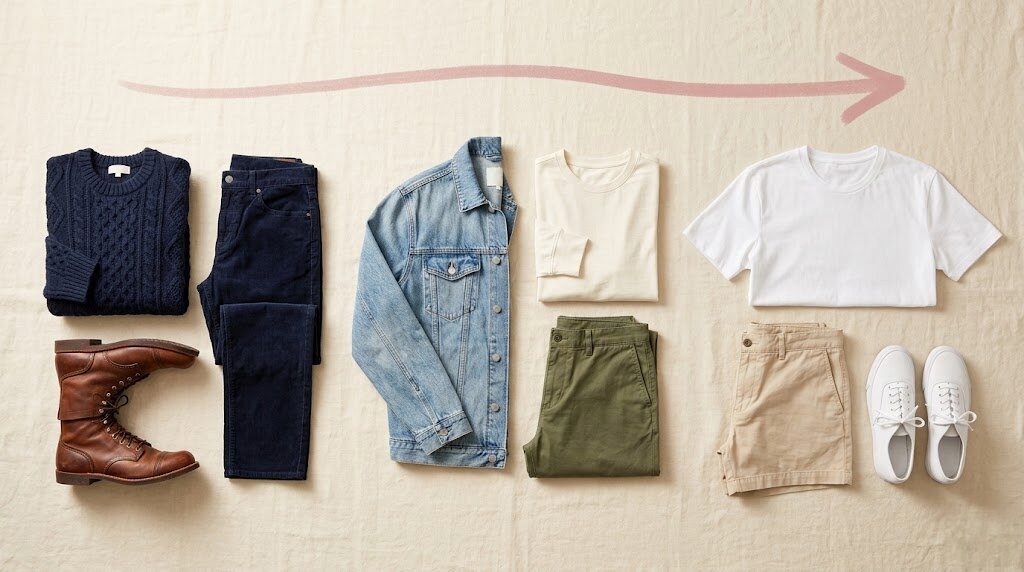
Every time the seasons shift, the same instinct kicks in: nothing in your closet works anymore, and you need to buy something new. March rolls around and suddenly your winter sweaters feel oppressive but your t-shirts feel premature. October arrives and you're staring at a closet full of shorts wondering when you accumulated so many tank tops. The result is usually a trip to the store, a handful of impulse purchases, and a growing pile of clothes you only wear for six weeks before the next transition hits.
Here's the thing most people don't realize: you probably already own everything you need for every season. The problem isn't your wardrobe — it's that you're thinking about seasonal dressing as a binary switch (summer clothes ON, winter clothes OFF) instead of what it actually is: a gradual transition that happens over 6-8 weeks where the right answer changes day by day based on the weather.
Why Seasonal Transitions Are the Hardest Days to Dress For
The middle of summer is easy. The middle of winter is easy. You know exactly what to wear because the weather is consistent and predictable. But the transitions — late February through April, and late September through November — are when outfit planning falls apart. A single week in March can include a 35°F morning, a 68°F afternoon, unexpected rain, and wind chill that makes 55°F feel like 42°F. No single outfit handles all of that.
This is exactly why weather-based outfit planning matters most during transitions. The daily high and low tell you almost nothing useful when the high is 70°F and the low is 42°F — what matters is when those temperatures occur relative to when you'll be outside. A 42°F morning commute followed by a 70°F lunch walk followed by a 50°F evening with rain at 6 PM requires three different outfit strategies, and you need to handle all three in a single set of clothes.
The transition zone: Spring and fall transitions typically last 6-8 weeks, during which daily temperature swings average 20-30°F. These are the weeks where most people make the most outfit mistakes — and where smart planning makes the biggest difference.
The Three-Phase Transition Strategy
Instead of swapping your entire closet overnight, think of seasonal transitions as three distinct phases. Each phase lasts about two weeks, and the key is knowing which phase you're in based on the weather forecast — not the calendar date.
Phase 1: The Overlap (first 2 weeks). The old season is still dominant but the new one is starting to show up. In spring, this means mornings are still genuinely cold (under 45°F) but afternoons occasionally hit the 60s. In fall, this means days are still warm but evenings are getting noticeably cool. During this phase, keep wearing your current-season clothes but start adding one piece from the next season as your adjustment layer. A winter outfit with a lighter jacket instead of a heavy coat. A summer outfit with a cardigan thrown in the bag.
Phase 2: The Mix (middle 2-3 weeks). Neither season fully owns the weather anymore. Days swing wildly — 50°F one day, 72°F the next. This is where layering becomes essential. Your outfit formula should be: one light base layer + one mid-weight piece + one easily removable outer layer. The base handles the warm peaks, the mid handles the cool baseline, and the outer handles the cold mornings and unexpected weather changes. This is also when you start rotating fabrics — swapping wool for cotton-blend, heavy denim for lighter chinos.
Phase 3: The Settle (final 2 weeks). The new season has arrived but hasn't fully committed. Spring days are mostly warm but cold snaps still happen. Fall days are mostly cool but the occasional 75°F day catches you off guard. During this phase, your new-season wardrobe takes over but keep 2-3 key pieces from the old season accessible — a light sweater in spring, a breathable layer in fall — for those regression days that always come.
The 10 Transition Pieces You Already Own
You don't need to buy anything new for seasonal transitions. You need to know which pieces in your existing closet are the most versatile across temperature ranges. Here are the ten categories that do the heaviest lifting during transitional weeks, and why they work.
1. The light jacket. Not your heavy winter coat, not your summer windbreaker — the mid-weight jacket that works from 45-65°F. For most people, this is a denim jacket, a light bomber, or an unlined blazer. It goes on for the morning commute and comes off by lunch. This single piece covers more transitional days than anything else in your closet.
2. Long-sleeve t-shirts. The most underused transitional item. Warmer than a t-shirt, lighter than a sweater, and works as a base layer under a jacket or on its own when temperatures are in the sweet spot (55-68°F). If you own long-sleeve tees, transition weeks are when they earn their cost per wear.
3. Chinos or dark jeans. Both work across seasons without looking out of place. Chinos in olive or navy transition from summer to fall effortlessly. Dark jeans work from winter through spring without looking too heavy. Avoid light-wash denim during fall transitions and white pants during spring transitions — they read wrong for the season.
4. Closed-toe versatile shoes. Sneakers, loafers, or chelsea boots that handle rain without looking like winter boots. Transitional weather is unpredictable, and water-resistant shoes that work with both casual and smart-casual outfits eliminate the daily shoe dilemma.
5. A packable rain layer. Not a full rain jacket — just a lightweight shell or windbreaker that folds into your bag. Spring rain is frequent but rarely heavy. Having a packable layer means you can dress for the warm afternoon and still be prepared for the 4 PM shower.
6. Scarves and lightweight knits. A scarf is the ultimate transitional accessory. It adds 5-10°F of perceived warmth to any outfit without changing the look. When you're on the edge between needing a jacket and not, a scarf is the answer. Light knit sweaters serve the same purpose as a mid-layer.
7. Button-downs in breathable fabrics. A cotton or linen button-down works as a light outer layer in warm transitions (unbuttoned over a tee) and as a primary layer in cool transitions (buttoned up with sleeves rolled). One piece, three seasons of use.
8. Lightweight sweaters. Merino wool or cotton-blend sweaters that aren't bulky enough for winter but provide enough warmth for cool spring mornings and fall evenings. These fill the gap between "t-shirt weather" and "jacket weather" that dominates transitional weeks.
9. Versatile shorts-to-pants transition bottoms. Joggers, chinos, and cargo pants that work in both warm and cool conditions. During the overlap phase, you'll want bottoms that don't scream "summer" or "winter" but sit comfortably in between.
10. Sunglasses and a hat. Spring sun is deceptively strong — UV index can hit 6+ well before summer officially starts. A baseball cap or wide-brim hat + sunglasses handle the sun without adding warmth you don't need. These are the accessories people forget to transition into their daily carry until they get sunburned in April.
The best transitional wardrobe isn't the biggest one. It's the one where every piece works with at least two others, across at least two seasons. Ten versatile items beat fifty specialized ones during the six weeks where weather doesn't follow the rules.
The Fabric Transition Calendar
One of the easiest ways to transition smoothly is to swap fabrics within the same clothing categories rather than swapping entire categories. You're still wearing sweaters in early spring — just lighter ones. You're still wearing t-shirts in early fall — just under a layer.
Winter → Spring fabric swaps: Heavy wool sweaters become lightweight cotton knits. Thick flannel becomes light flannel or chambray. Thermal base layers become standard long-sleeve tees. Corduroy becomes chinos. Heavy boots become ankle boots or leather sneakers. Down jackets become light bombers or denim jackets.
Summer → Fall fabric swaps: Linen becomes cotton. Thin cotton tees become heavier cotton or cotton-blend tees. Shorts become chinos or joggers. Sandals become sneakers or loafers. Tank tops become long-sleeve tees. The key principle is: keep the silhouette similar but increase the fabric weight by one step.
How Weather Apps Make Transitions Easier
The hardest part of transitional dressing isn't knowing what to wear — it's knowing what the weather will actually do on any given day. A calendar says "March 15" but the weather could be anything from 38°F with sleet to 72°F with sunshine. This is where checking the full-day forecast becomes the single most valuable habit for transitional dressing.
Apps like Dresr analyze the feels-like temperature hour by hour — not just the daily high and low — and recommend outfits that account for the full range. On a day where the morning feels like 42°F but the afternoon feels like 65°F, Dresr might suggest a long-sleeve tee with a light jacket and chinos, knowing you'll remove the jacket by noon. That's the kind of recommendation that turns a frustrating transitional day into an effortless one.
The most underrated feature for transitions is the daily timeline view. Seeing exactly when the temperature drops and when rain arrives lets you plan your layers with precision instead of guessing. You stop overdressing for cool mornings and underdressing for cool evenings because you can see both coming.
The Declutter Opportunity
Seasonal transitions are the best time to evaluate your wardrobe, because you're touching every piece anyway. As you rotate items in and out of your active closet, apply a simple test: did I wear this at all last season? If you own a winter sweater you didn't wear once between November and February, it's not serving you. If you have summer shorts you forgot existed until June, they're taking up space that a more versatile piece could use.
The goal isn't minimalism for its own sake. It's building a wardrobe where every item earns its spot by being worn regularly and working well with other pieces. A capsule wardrobe of 30-40 well-chosen items that covers all four seasons is more useful than 100 items where half sit unworn for months at a time.
The bottom line: Seasonal wardrobe transitions don't require new purchases. They require knowing which pieces you already own are the most versatile, understanding the three phases of transition, and checking the full-day weather forecast before getting dressed. The weather changes gradually — your wardrobe should too.