
It's 7:15 AM. Your alarm went off twenty minutes ago. You've showered, brushed your teeth, poured your coffee — and now you're standing in front of an open closet, staring at a wall of clothes, asking yourself the same question you ask every single morning: what should I wear today?
You're not alone. Studies suggest that the average person spends roughly 17 minutes every morning deciding what to wear, and still feels uncertain about the result nearly half the time. Over the course of a year, that adds up to more than 100 hours — over four full days — spent on a decision that shouldn't be this hard. The problem isn't that you don't own enough clothes. It's that you're making the decision with incomplete information and no system.
Why Choosing What to Wear Feels So Hard
The difficulty of getting dressed in the morning isn't really about fashion. It's about decision fatigue — the psychological phenomenon where the quality of your decisions deteriorates after making too many of them. By the time you're standing in front of your closet, your brain has already processed dozens of micro-decisions since waking up: when to get out of bed, what to eat, whether to check your phone, which notifications to respond to. Your outfit becomes one more cognitive load stacked on top of an already taxed system.
But there's a deeper issue: most people choose their outfit based on how they feel in that exact moment, not based on what they'll actually experience throughout the day. You glance out the window, see sunshine, and reach for a light top. By 3 PM, the temperature has dropped 15 degrees and you're freezing through your afternoon meetings. Or you check the weather app, see "62°F," and dress accordingly — without realizing that 62°F with 20 mph wind and overcast skies feels completely different from 62°F with calm air and sunshine.
The real problem: You're not bad at getting dressed. You're making a complex decision — one that involves weather, schedule, comfort, and style — with almost no data. No wonder it feels hard every morning.
The Weather Factor Most People Ignore
Here's what makes the "what should I wear today" question genuinely tricky: weather isn't static. The temperature at 7 AM when you leave for work is often dramatically different from the temperature at noon when you step out for lunch, and different again from 6 PM when you head home. The average daily temperature swing in most U.S. cities is about 20°F, and in places like Denver, San Francisco, and Phoenix, swings of 30°F or more are common in spring and fall.
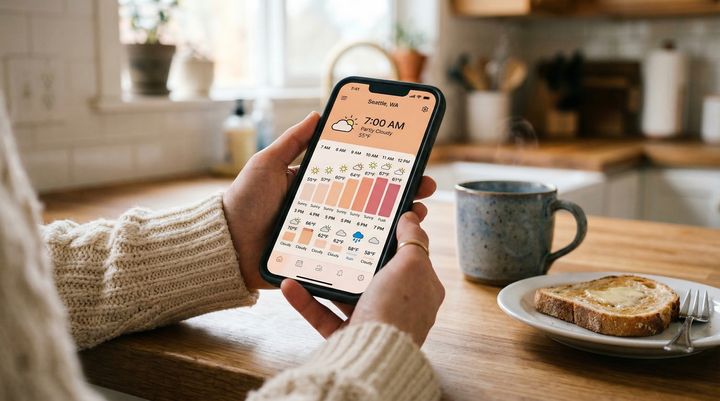
Traditional weather apps show you the current temperature and a daily high/low. But that information alone doesn't answer the outfit planning question. What you actually need to know is: what will the weather be during the specific hours I'll be outside? Is it going to rain during my commute? Will the wind pick up in the afternoon? Is the morning cold enough for a jacket that I'll need to carry around by lunch?
When you plan your outfit around the full-day weather forecast instead of a single temperature reading, something shifts. You stop dressing for one moment and start dressing for your entire day. That's the difference between grabbing a random jacket and choosing a specific layer you can easily remove and stash in your bag when the afternoon warms up.
The Outfit Formula That Saves 10 Minutes Every Morning
Professional stylists don't start from scratch every day. They use outfit formulas — repeatable combinations of clothing types that always work together. Once you have a few formulas memorized, getting dressed becomes assembly rather than invention. You're not creating something new every morning; you're selecting from a menu of proven combinations.
Here's a simple framework that works for most people and most weather conditions. Think of every outfit as having three components: a base layer (the thing closest to your skin that handles temperature), an anchor piece (the item that defines the outfit's style — usually your top or dress), and an adjustment layer (the piece you add or remove based on conditions — a jacket, cardigan, or vest).
When you think in these three categories, choosing an outfit becomes three small decisions instead of one overwhelming one. Pick a base appropriate for the low temperature of the day. Pick an anchor that matches your schedule (casual for working from home, polished for client meetings). Pick an adjustment layer based on the temperature range and rain probability. Done. The whole process takes two to three minutes instead of fifteen.
Your Closet Already Has the Answer
One of the most common reactions to "what should I wear today" stress is to buy more clothes. The logic feels sound: if nothing in your closet works, you need new options. But research consistently shows that people only wear about 20% of the clothes they own on a regular basis. The other 80% sits untouched — not because those pieces are bad, but because you've forgotten about them or you don't know when to reach for them.
The real opportunity isn't buying more. It's knowing what you already have and understanding when each piece is the right choice. A lightweight merino pullover that's been sitting in your drawer since last fall might be the perfect adjustment layer for a spring day that starts at 50°F and warms to 68°F. Those dark chinos you haven't worn in months might be exactly right for a day with afternoon rain because they don't show water spots. You already own the wardrobe. You just need a system that connects the right pieces to the right conditions.
Five Practical Changes to End Morning Outfit Stress
If the "what should I wear today" spiral is eating your mornings, here are five changes that make an immediate difference. These aren't theoretical — they're the strategies that people who consistently get dressed in under five minutes actually use.
1. Check the hourly forecast, not just the temperature. This is the single highest-impact change. Knowing that it's 55°F right now is far less useful than knowing it'll be 55°F at 8 AM, 72°F at 1 PM, and 58°F with a 40% chance of rain at 6 PM. The hourly breakdown turns a guessing game into a planning exercise. Dresr shows you this hour-by-hour timeline and matches it to outfit suggestions from your actual closet.
2. Lay out your outfit the night before. This sounds simple because it is. Moving the decision from a rushed morning to a relaxed evening eliminates decision fatigue entirely. You have more mental energy, more time to check tomorrow's forecast, and zero pressure. Even doing this two or three times a week makes a noticeable difference in your morning flow.
3. Build five go-to outfit formulas. You don't need a formula for every occasion. Just five reliable combinations — one for cold days, one for mild days, one for warm days, one for rainy days, and one "I have something important today" outfit — cover 90% of your mornings. Write them down or save photos of them. When you can't think, default to a formula.
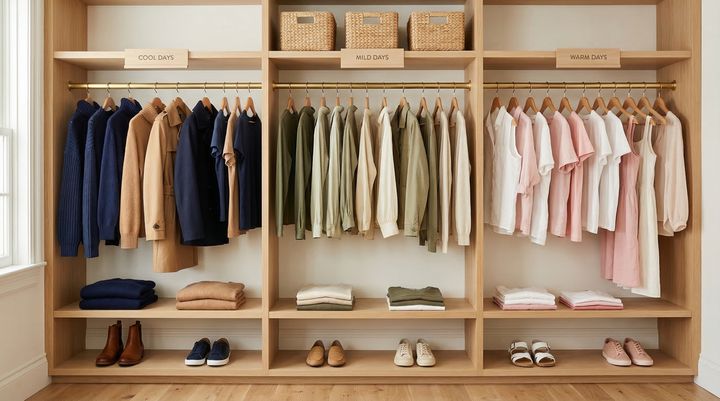
4. Organize your closet by weather, not by type. Instead of grouping all shirts together and all pants together, try grouping by temperature range. Light layers in one section, mid-weight pieces in another, heavy winter items in a third. When you check the forecast and see "chilly morning, warm afternoon," you know exactly which section of your closet to reach into.
5. Take a photo when an outfit works. Whenever you put on an outfit and think "this looks great," take a quick photo. Over time, you'll build a visual library of proven combinations that you can flip through on difficult mornings instead of starting from zero. It's like having a personal lookbook of outfits you already know work.
The goal isn't to look perfect every day. It's to look good enough in five minutes or less, so you can spend your mental energy on the things that actually matter.
When the Weather Changes Everything
The hardest mornings aren't the ones where it's clearly hot or clearly cold. They're the in-between days — the 55-65°F range where anything from a t-shirt to a light jacket could theoretically work, depending on wind, humidity, cloud cover, and your personal schedule. These are the days where people waste the most time deciding what to wear, because there's no obvious answer.
This is exactly where weather-based outfit planning shines. Instead of looking at a single number and guessing, you see the full picture: that it's 58°F and calm at 8 AM but will feel like 50°F by 5 PM because of 18 mph wind and cloud cover rolling in. That context turns an impossible question into a straightforward one. You grab your light jacket — not because it's cold right now, but because you know you'll need it later.
The morning question of "what should I wear today" doesn't have to be a daily source of stress. It just requires two things: knowing what the weather will actually do throughout your day, and having a quick system for matching that information to clothes you already own. Understand the importance of weather-based outfit planning to see how the full-day forecast transforms your morning routine. Solve both problems, and you'll never stand paralyzed in front of your closet again.
The bottom line: Getting dressed shouldn't take 17 minutes. Check the full-day forecast, use an outfit formula, and dress for the whole day — not just the moment you walk out the door. Your mornings are about to get a whole lot smoother.