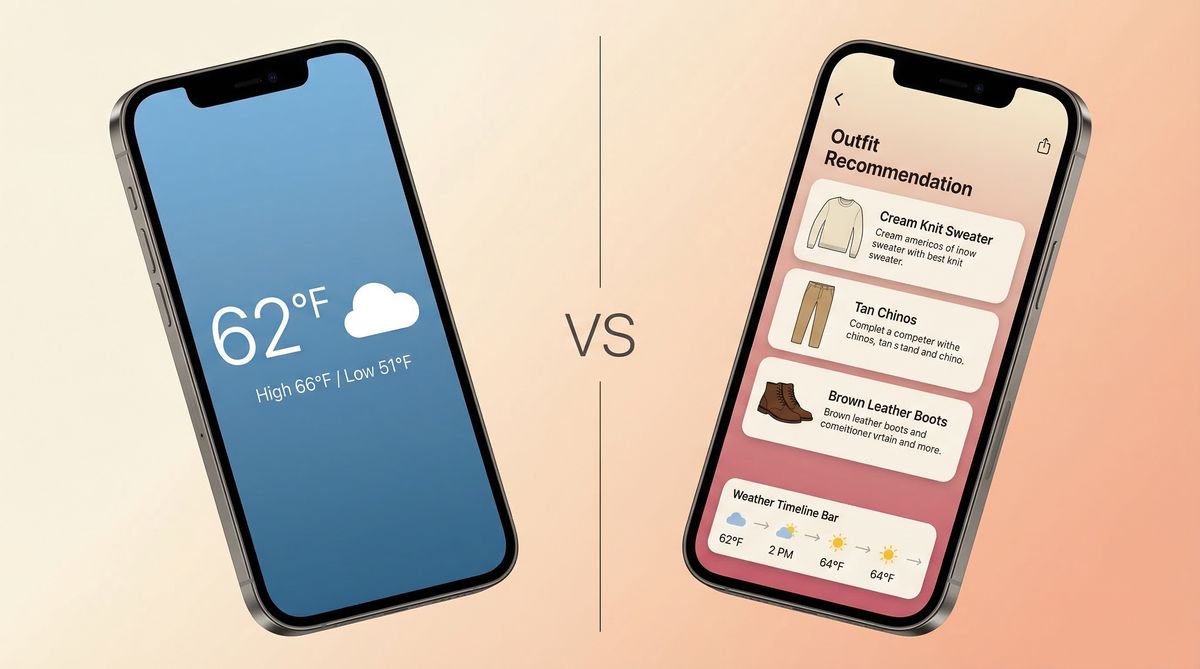
Everyone checks the weather before getting dressed. You glance at your phone, see "62°F and partly cloudy," and make a snap judgment about what to wear. It's a ritual so automatic that you probably don't even think about it. But here's the thing: that number alone is almost never enough information to actually get dressed well.
Dresr was built because we realized something obvious that nobody was solving: knowing the weather and knowing what to wear are two completely different problems. Your weather app is excellent at the first one. It was never designed to solve the second. This post breaks down exactly where the gap is — and why it matters more than you'd think. (Want to see Dresr in action? Check out how it actually works.)
What Your Weather App Actually Tells You
Open any weather app right now. You'll see the current temperature, a high and low for the day, a weather icon (sunny, cloudy, rainy), and maybe wind speed and humidity. Some apps show an hourly forecast if you scroll down. This information is accurate and useful — but it answers a fundamentally different question than "what should I wear?"
The weather app tells you what's happening outside. It doesn't tell you what that means for your body, your schedule, your wardrobe, or your comfort. It says "58°F" — but is that 58°F with 25 mph wind (which feels like 48°F on exposed skin) or 58°F in calm sunshine (which feels like 65°F when you're walking)? It says "30% chance of rain" — but is that during your morning commute or at 2 AM while you're sleeping? These distinctions make the difference between a great outfit day and a miserable one.
The core problem: Weather apps are designed to communicate atmospheric conditions. Getting dressed requires translating those conditions into clothing decisions — accounting for your schedule, your body, and what you actually own. That translation step is what's missing.
What Dresr Does Differently
Dresr starts where your weather app stops. It takes the same weather data — temperature, wind, humidity, UV, precipitation — but instead of just displaying it, Dresr interprets it through the lens of getting dressed. The output isn't a number or an icon. It's a complete outfit recommendation from your own closet.
Here's the key difference in how information flows. Your weather app says: "High of 72°F, low of 54°F, 40% rain at 5 PM, wind 12 mph." That's five separate data points you have to mentally combine and then match against your wardrobe. Dresr processes those same five data points and says: "Wear your cream henley with the olive chinos, bring your navy jacket for the evening cool-down, and grab the leather boots since rain is likely during your commute home." One requires your brain to do the work. The other does it for you.
The Hourly Gap
Most weather apps show you the current temperature prominently — it's the big number on the home screen. Some show a daily high/low. Very few make the hourly forecast easy to scan at a glance. But the hourly forecast is the single most important piece of data for getting dressed, because weather isn't static.
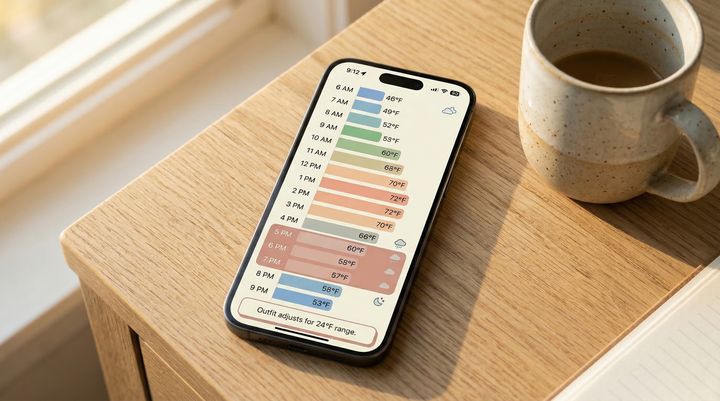
Consider a typical spring day: 48°F at 7 AM when you leave for work, warming to 72°F by 1 PM, then dropping back to 55°F by 6 PM with rain rolling in at 5. If you dress for the 48°F morning, you'll be sweating by lunch. If you dress for the 72°F peak, you'll freeze on the commute. The right answer is a layered outfit that works across the full range — and that's exactly what Dresr's daily timeline is designed to produce.
Dresr shows you the full day's weather trajectory in a visual timeline and builds your outfit around the entire range, not just a single reading. It accounts for when you'll be outside, when the temperature shifts, and when precipitation is most likely to hit.
The Wardrobe Problem
Even if you're great at reading weather data, there's a second problem your weather app can't solve: matching conditions to clothing. Knowing that you need "a light jacket" is different from knowing which light jacket — the windproof one for breezy days, the water-resistant one for rain threats, or the breathable one for humid warmth.
This is where Dresr's wardrobe integration makes the biggest difference. Because you've added your actual clothes — with photos, colors, and material weights — Dresr doesn't give generic advice. It recommends specific pieces you own. The navy windbreaker for Tuesday's gusty commute. The cream merino pullover for Wednesday's cool-but-calm morning. The dark chinos instead of light ones on Thursday because of afternoon rain. Every recommendation is grounded in reality — your reality, not a hypothetical closet.
Your weather app has no idea what's in your closet. It can't distinguish between your three jackets or know that your favorite boots leak in heavy rain. Dresr can.
Side-by-Side: What You Get from Each
| Feature | Weather App | Dresr |
|---|---|---|
| Current temperature | Yes | Yes |
| Daily high/low | Yes | Yes |
| Hourly forecast | Some apps | Visual timeline |
| "Feels like" with wind/humidity | Sometimes | Factored into outfit |
| Rain timing (which hours) | Rarely specific | Hour-by-hour |
| Complete outfit suggestion | No | Top, bottom, shoes, layers |
| Uses YOUR wardrobe | No | Your actual clothes |
| Color coordination | No | Yes |
| Learns your style | No | Improves over time |
| Travel packing lists | No | From your wardrobe |
| Morning outfit notification | No | Before you get dressed |
When a Weather App Is Enough
Let's be fair: there are days when checking the weather is all you need. If it's 85°F and sunny, you're wearing shorts and a t-shirt. If it's 20°F and snowing, you're wearing your heavy coat. The weather app is perfectly adequate for weather extremes because the clothing choice is obvious.
But those clear-cut days are maybe 30% of the year. The other 70% — the transitional spring and fall days, the days with afternoon rain, the mornings that start cold and warm up 20 degrees, the humid summers where 78°F feels like 90°F — those are the days where a weather app leaves you guessing and Dresr gives you a clear answer.
You don't replace your weather app with Dresr. You stop using your weather app to make clothing decisions. That's the difference.
The Real Cost of "Close Enough"
Most people settle for "close enough" when getting dressed. You check the weather, make a rough guess, and accept that you'll be slightly too warm or slightly too cold for part of the day. It feels like a minor inconvenience — until you add it up.
Being slightly too cold in a meeting means you're distracted and less focused. Being too warm on your commute means you arrive sweaty and self-conscious. Carrying a jacket you didn't need means one hand is occupied all day. Getting caught in rain you didn't dress for means an emergency shopping trip or an uncomfortable afternoon. These small friction points accumulate into a persistent low-grade stress that most people don't even notice because they've accepted it as normal.
Dresr eliminates that friction entirely. Not by giving you better weather data — your weather app already has great data — but by doing the thinking that turns data into a decision. The result is that you spend less mental energy getting dressed, feel more comfortable throughout the day, and stop having those "I wish I'd worn something different" moments by 3 PM.
They Work Better Together
Dresr doesn't replace your weather app — it completes it. Your weather app is still the best tool for knowing whether to bring an umbrella to a picnic or whether tomorrow's flight might be delayed. Dresr is the tool that takes weather data and turns it into practical outfit decisions for your daily routine.
Think of it this way: your weather app is like a thermometer in your kitchen. It tells you the oven is at 375°F. Dresr is the recipe that tells you what to cook at 375°F, for how long, and with which ingredients you already have in your fridge. Same data, completely different output.
The bottom line: Your weather app tells you what's happening outside. Dresr tells you what to wear about it — using clothes you actually own, accounting for your full day's schedule, and learning your preferences over time. Together, they make sure you never overdress, underdress, or stand in front of your closet wondering again.